
 program konferencji
Konferencje
Międzynarodowa konferencja
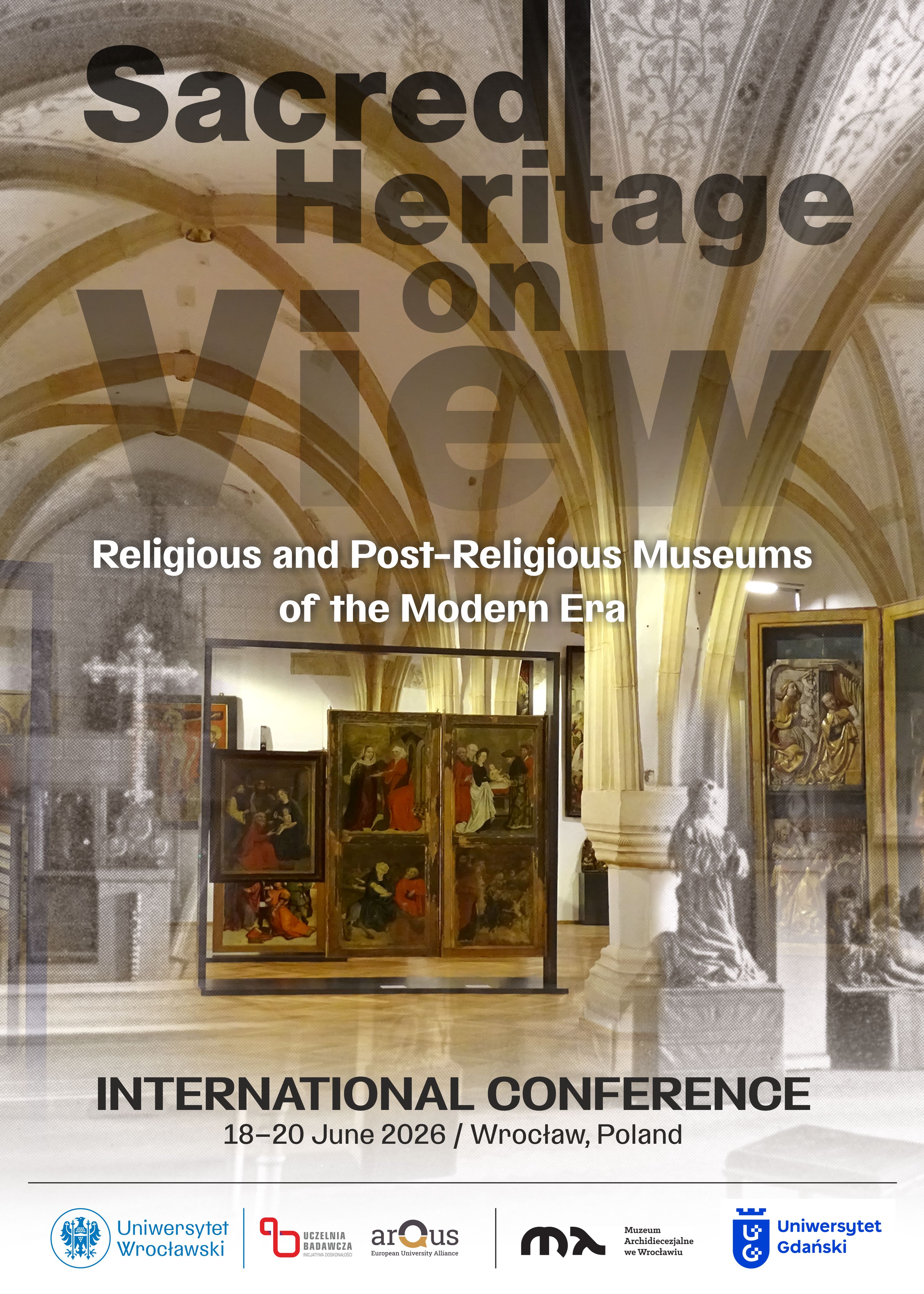
Sacred Heritage on View. Religious and Post-Religious Museums of the Modern Era
18–20 June 2026, Wrocław, Poland
Gorąco zachęcamy do wysłuchania wystąpień prezentowanych w ramach międzynarodowej konferencji poświęconej muzeom religijnym i postreliginym.
Program konferencji:
Linki do relacji online:
Dzień pierwszy (18.06)
https://www.youtube.com/live/MoR6sH4z70w?si=956RnzT4sFtFlhI0
Dzień drugi (19.06)
https://www.youtube.com/live/R1CGA2aLUIg?si=OqlWhV8ynqmwrgGp
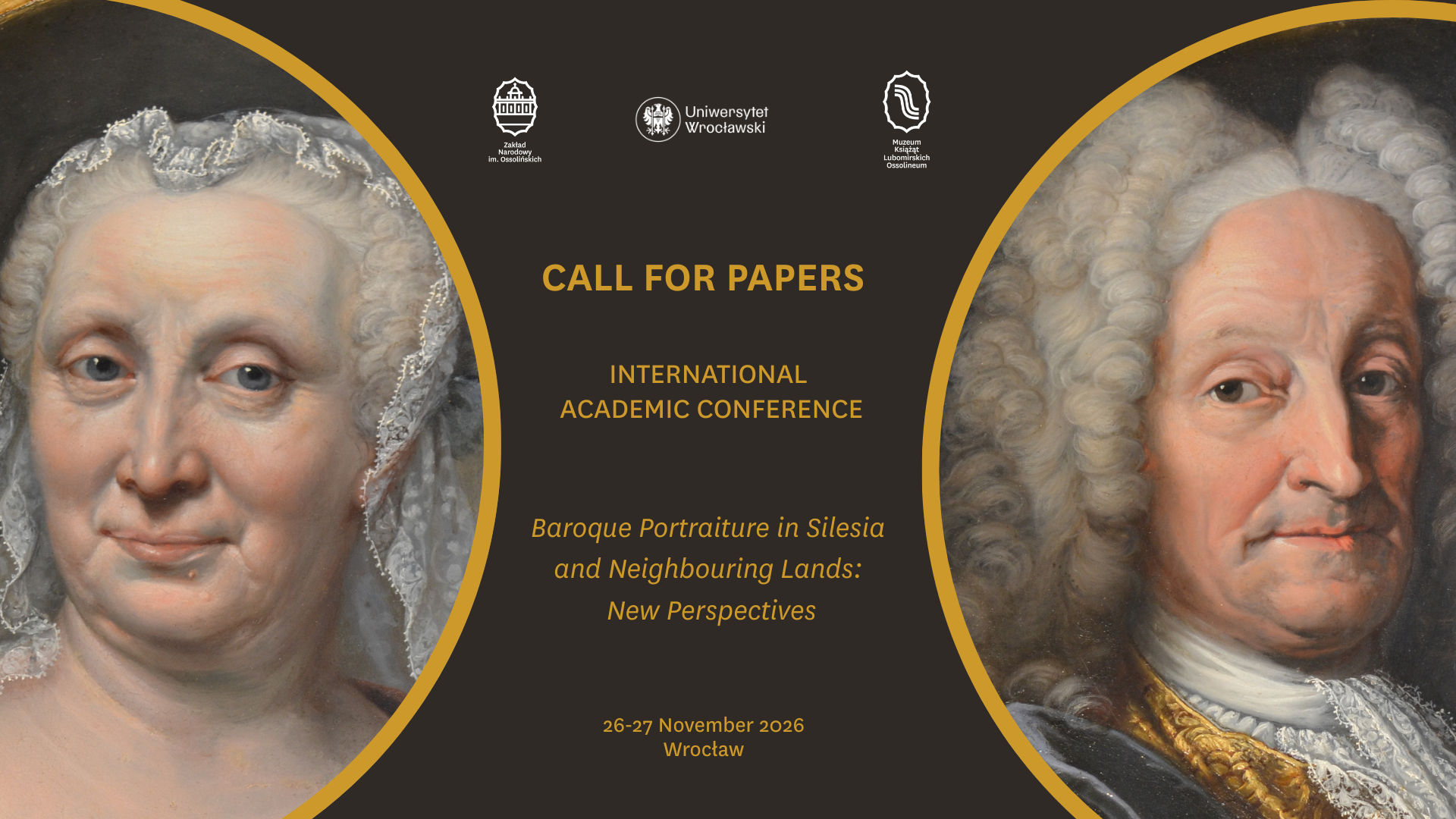
CALL FOR PAPERS
International Academic Conference
Baroque Portraiture in Silesia and its Neighbouring Lands: New Perspectives
The Ossoliński National Institute, Wrocław
26-27 November 2026
Organisers:
Institute of Art History, University of Wrocław
The Ossoliński Institute in Wrocław
Scientific Committee:
doc. Mgr. Katarína Kolbiarz Chmelinová, PhD., Comenius University Bratislava
Prof. dr hab. Andrzej Kozieł, University of Wrocław, University of Ostrava
Mgr. Zuzana Macurová, Ph.D., Palacký University Olomouc
Prof. dr hab. Jacek Tylicki, Nicolaus Copernicus University in Toruń
Organising Committee:
Dr Emilia Kłoda, The Ossoliński National Institute in Wrocław
Dr Marek Kwaśny, Institute of Art History, University of Wrocław
Following the end of the Thirty Years’ War and the signing of the Peace of Westphalia in 1648, Silesia, as a land belonging to the Bohemian Crown, became the arena of fundamental political and social transformations. In place of the local Protestant nobility, new cosmopolitan aristocratic families of the Catholic faith emerged, loyal to the imperial authority. The confessional character of the Habsburg state fostered the renewal of religious life and increased the influence of ecclesiastical institutions on politics, culture, and society. These changes manifested themselves in numerous and magnificent artistic foundations. Noble and episcopal palaces, monasteries, and academies filled with art, with portraiture occupying a particularly prominent place. Alongside images of the ruler and his family – expressions of political loyalty – noble portrait galleries comprised likenesses of contemporary family members and their most illustrious ancestors. Thus created, the ancestor halls were intended as an artistic manifestation of high status, aspirations, and proof of noble lineage. Bishops’ palaces were adorned with portraits of successive church hierarchs, while the representative halls of monasteries were filled with extensive portrait cycles depicting subsequent abbots and abbesses. These often included imaginative representations of semi-legendary early superiors, reaching many centuries back, thereby underscoring institutional continuity and sanctioning the communities’ exceptional social position.
On the other hand, despite a more difficult political and religious situation, numerous portrait commissions also came from the numerically dominant Protestant inhabitants of Silesia: wealthy burghers, councillors, scholars, humanists, and Lutheran clergy, equally eager to emphasise their significance as prosperous and educated representatives of society. It must of course be remembered that the portrait in this period served various functions: from the most fundamental one of "making the absent present," through representative, ritual, propagandistic, and commemorative roles, to finally serving as a tool of self-creation and manifestation of identity (social, political, and religious).
Thanks to extensive field research conducted in recent years, we know of over 800 surviving Baroque portraits of various types located in Silesian museums, palaces, monasteries, and public institutions. Despite such a rich heritage, many aspects of this artistic activity still await new, interdisciplinary approaches. Suffice it to say that over forty years have passed since the last exhibition on early modern portraiture in Silesia, organized by the National Museum in Wrocław, and since then no comprehensive, overarching study has been dedicated to this subject, leaving it on the margins of other art-historical inquiries.
Therefore, the Institute of Art History of the University of Wrocław and the Ossoliński National Institute invite you to participate in an international academic conference devoted to early modern portraiture in Silesia and its neighbouring lands. The artistic phenomena observable in Silesia were similar in other lands of the Bohemian Crown, while the Polish-Lithuanian Commonwealth had extraordinary patrons of portraiture among its magnates and high-ranking clergy. We invite you to jointly reflect on the place of the portrait in the visual culture of Central Europe, on its functions, meanings, and transformations over the centuries. We are open to new methodological perspectives and various interdisciplinary approaches that take into account the socio-economic conditions of the epoch and region. We welcome not only scholars interested in painted portraiture but also in sculptural, graphic, and drawn portraits.
PROPOSED THEMATIC AREAS
We encourage the submission of papers addressing, among others, the following topics:
- The portrait and its function: representation of power, propaganda, commemoration, self-creation, the portrait as an object of exchange
- Historicising portraiture and sacred identification portraits
- The portrait and the sitter’s identity: confession, estate, nationality, gender
- Portraitists and their place in the art market: the artistic activity of portrait painters and guild structures with their constraints, secular and ecclesiastical servitorate, artist mobility and earnings
- The portrait and its display: residential ancestor galleries, monastic portrait cycles of abbots and abbesses, collections of portraits of famous figures, scholars and professors, bourgeois interiors, images in public spaces, epitaphs and tombstones
- The portrait in sculpture, numismatics, graphic arts, and decorative arts
- The turbulent fate of portraits: translocations, destruction, thefts, restitution
The thematic scope remains flexible. We will gladly consider proposals that extend beyond the aforementioned areas.
SUBMISSION GUIDELINES
- Speaking time: 20 minutes
- Conference languages: English
Please send your proposals by 31 July 2026 to:
marek.kwasny2@uwr.edu.pl
Submissions should include:
- Full name, academic title/degree, affiliation
- Paper title
- Abstract (max. 200 words)
- Short biographical note
- Notification of acceptance will be sent by 31 August 2026.
CONFERENCE PUBLICATION
We plan to publish a peer-reviewed post-conference monograph in English with a high-scoring academic publisher.
FEES AND PRACTICAL INFORMATION
- Conference Fee: 450 PLN / 100 EUR
- The fee includes: Conference materials, coffee breaks, lunches, and a gala dinner.
- Travel and Accommodation: Please note that the organizers do not cover travel or accommodation expenses. However, we are happy to assist with hotel reservations where possible.
The Fifteenth Annual REFORC Conference will take place May 19-May 21, 2026, hosted by the University of Wrocław (in cooperation with the University of Cologne and the University of Bonn). Short paper submission and registration are open.
Theme Plenary Speakers: Early Modern Christian Materiality
At the time of the Reformation, new ways of perceiving bodiliness and materiality began to reshape Western thought, particularly in relation to the understanding of the Incarnation and the Eucharist. In a sharp critique of medieval Aristotelianism, especially the doctrine of transubstantiation grounded in Aristotelian hylomorphic theory, the Reformers developed new understandings of Christ’s presence, the Holy Spirit, human being, and the material world. While these reinterpretations varied among the different reformers, they commonly marked a departure from medieval theological frameworks and opened the door to (re)configurations in how materiality was understood, experienced, and practiced. The reconfigured understanding of the sacraments had a substantial influence on liturgy and, consequently, also on ecclesiastical art, architecture, and music. Likewise, the role of materiality in everyday domestic piety was reassessed, reflecting broader theological reconsiderations of how the sacred could be mediated through physical forms.
More information on the website: https://reforc.com/events/fifteenth-annual-reforc-conference-on-early-modern-christianity/
INTERNATIONAL CONFERENCE
Sacred Heritage on View
Religious and Post-Religious Museums of the Modern Era
18–20 June 2026, Wrocław, Poland
Deadline: 15 January 2026
Call for Papers
Artefacts associated with religious worship form a significant part of the collections held by numerous types of museums. The Institute of Art History at the University of Wrocław, in collaboration with the Archdiocesan Museum in Wrocław, invites you to participate in a conference devoted to museums that focus on collecting objects of religious heritage and regard their public presentation as a central aspect of their mission.
The inspiration for organising the conference is the reopening of the Archdiocesan Museum in Wrocław. Following several years of renovation, this Catholic institution, with a history spanning over 120 years, was reopened to the public in 2024 with a a completely renewed exhibition. While wishing to situate the Wrocław museum within the context of comparable institutions, we do not, however, intend to restrict the thematic scope of the conference to the sphere of Catholic or Christian collections. On the contrary, we aim to encourage a broader discussion concerning the collection and display of sacred heritage from a variety of religions and denominations, undertaken by different types of museums.
Our primary focus is on museums operating within the organisational structures of various religious denominations, as well as those managed by entities identifying with religious teachings. We are also interested in former places of worship and prayer (including temples, churches, synagogues, mosques, and others) which, no longer serving religious functions, have been transformed into museums dedicated to the preservation and presentation of sacred heritage in as integral a form as possible. It is primarily with such institutions in mind that we have used the term ‘post-religious museums’ in the title of the conference. We also propose including in this category various types of secular institutions which, having no religious agenda per se, collect and exhibit artefacts once used in worship and present their histories to audiences in a secularising world.
The main issues we wish to discuss are:
- the musealisation of objects used for worship within religious and post-religious museums – between secularisation and the preservation of (the illusion of) sanctity
- the role and functioning of former places of worship converted into museums – the theatrum sacrum in the era of secularisation
- works of art, objects of artistic craftsmanship, archaeological and ethnographic artefacts, etc. – the diversity of collections in religious and post-religious museums and the methods of their classification
- monoreligious museums versus those collecting the heritage of various religions and denominations
- non-religious (secular) objects in the collections of religious and post-religious museums – the reasons for their acquisition and their place in relation to the dominant sacred exhibits
- buildings of religious and post-religious museums in relation to the traditions of sacred and museum architecture – their ideological programmes, formal characteristics, and functional solutions.
In addition, a separate panel is planned, devoted to the Archdiocesan Museum in Wrocław. We invite contributions examining the history, profile, and collections of this institution, as well as its position within the wider context of other Catholic diocesan museums.
The topics to be addressed at the conference fall within the scope of interest of a range of academic disciplines and research traditions. Accordingly, we aim for our meeting to be interdisciplinary in nature. We invite specialists in art history, museology, cultural and religious studies, archaeology, heritage studies, and related fields to participate in the conference.
Proposals that do not directly address the issues identified above are also welcome.
Presentations should last no longer than 20 minutes. The official language of the conference is English.
CONFERENCE DETAILS
Organising institutions
The University of Wrocław Institute of Art History
The Archdiocesan Museum in Wrocław
Date
18–20 June 2026
Conference venues
The Institute of Art History, ul. Szewska 36, Wrocław
The Archdiocesan Museum, pl. Katedralny 16, Wrocław
Submission guidelines
Contribution proposals, including a 200-word abstract and a short biographical note, should be emailed by 15 January 2026 to agata.kubala@uwr.edu.pl and joanna.lubos-koziel@uwr.edu.pl
Notification of acceptance of contributions will be sent by 15 February 2026.
Conference fee
The conference fee is €150 and €120 for PhD candidates. The fee includes meals (lunch Thu–Sat, dinner Thu–Fri) and conference materials.
Post-conference publication
After the conference, selected papers will be published in a double-blind peer-reviewed volume.
Organising committee
Dr hab. prof. UWr Agata Kubala (University of Wrocław Institute of Art History)
Dr Joanna Lubos-Kozieł (University of Wrocław Institute of Art History)
Dr Milena Woźniak-Koch (University of Gdańsk Institute of Art History)
Scientific Committee:
Prof. Mgr. Ondřej Jakubec, Ph.D. (Masaryk University Art History Department)
Dr hab. prof. UW Hubert Kowalski (University of Warsaw Faculty of Archaeology)
Dr Zvi Orgad (Bar Ilan University Department of Jewish Art)
Dr hab. prof. UWr Renata Tańczuk (University of Wrocław Institute of Cultural Studies)
Mexican Art and Its Collections in Europe (16th–21st Centuries): Interwoven Histories
21 maja 2025, godz. 9:00 | Platforma: MS Teams
Instytut Historii Sztuki Uniwersytetu Wrocławskiego zaprasza do udziału w międzynarodowej konferencji naukowej poświęconej obecności sztuki meksykańskiej w europejskim kontekście kulturowym – od czasów kolonialnych po współczesność.
Konferencja stanowi forum interdyscyplinarnej refleksji nad procesami gromadzenia, prezentowania i reinterpretacji sztuki meksykańskiej w Europie. Szczególna uwaga zostanie poświęcona problematyce transferu kulturowego, praktykom kuratorskim i muzealnym, biografiom dzieł oraz metodologicznym wyzwaniom związanym z badaniem tych zjawisk z perspektywy postkolonialnej i transnarodowej.
Język konferencji: angielski
Rejestracja: https://teams.microsoft.com/meet/3683198775580?p=LTk0JmvBbg9pxXkmVF
Serdecznie zapraszamy badaczy, kuratorów, muzealników i wszystkie osoby zainteresowane sztuką Meksyku, historią kolekcjonowania oraz studiami nad dziedzictwem kulturowym.
International Online Conference: Mexican Art and Its Collections in Europe (16th–21st Centuries): Interwoven Histories May 21, 2025, 9:00 AM | Platform: MS Teams
The Institute of Art History at the University of Wrocław invites you to participate in an international academic conference dedicated to the presence of Mexican art in the European cultural context - from colonial times to the present day.
The conference serves as a forum for interdisciplinary reflection on the processes of collecting, presenting, and reinterpreting Mexican art in Europe. Special attention will be given to issues of cultural transfer, curatorial and museum practices, biographies of artworks, and methodological challenges related to studying these phenomena from postcolonial and transnational perspectives.
Conference language: English
Registration: https://teams.microsoft.com/meet/3683198775580?p=LTk0JmvBbg9pxXkmVF
We cordially invite researchers, curators, museum professionals, and all those interested in Mexican art, the history of collecting, and cultural heritage studies.

Ilustracja z „Historia de los Indios de Nueva España e Islas de Tierra Firme” Diego Durána (tzw. Codex Durán, 1581 r.) przedstawiająca mityczne założenie Tenochtitlán.
Illustration from "Historia de los Indios de Nueva España e Islas de Tierra Firme" by Diego Durán (known as Codex Durán, 1581) depicting the mythical foundation of Tenochtitlán.
The Greek Revival and the Gothic Revival Reception of Ancient Greek and Medieval Art and Culture in the Period between 1750 and 1850 – Theory and Practice
13–15 October 2022 Institute of Art History, University of Wrocław, Poland
Thursday, October 13
9.00 am Opening of the conference Romuald Kaczmarek (Director of the Institute of Art History, University of Wrocław)
9.15–10.00 am Opening lecture: Contradictio in adiecto. Gothic Greek Revival – Greek Gothic Revival? Klaus Niehr (University of Osnabrück and Academy of Sciences in Göttingen)
10.00–10.15 am COFFEE BREAK
I. 18th Century Architecture – Theory
CHAIR:
10.15–10.35 am Christian Rieger's “Universae architecturae civilis elementa” (1756) and Laugier's “Primitive Hut” (1755) Berthold Hub (University of Vienna)
10.35–10.55 am Zwischen Goethe und Schlegel, Polygnot und Dürer, Theorie und Praxis. Die Kunst der Brüder Riepenhausen im Spannungsfeld von Antike und Gotik Ulf Dingerdissen (University of Georg-August, Göttingen)
10.55–11.15 am DISCUSSION
II. Architecture and Gardens in the 18th and 19th Centuries
CHAIR:
11.15–11.35 am Neo-Gothic or Gothic Revival? Attitudes Toward Late Medieval Architecture in the Long 18th Century – the Portuguese Case Madalena Costa Lima (University of Lisbon)
11.35–11.55 am Between Greek and Gothic: French Funerary Architecture in the First Half of the 19th Century Eric Sergent (Université Lumière, Lyon)
11.55 am – 12.15 pm “All Collected by a Visible Hand, Which Instilled Old Spirit to a New Work”. About Forms and Experience of the „Rococo-Gothic” Structures in the 18th Century Gardens Anna Oleńska (Polish Academy of Sciences Institute of Art, Warsaw)
12.15–12.35 pm “Classical Gothic” – Hybrid Interior Designs by Robert Adam and John Soane in England (1760s–1805) Daniela Roberts (University of Würzburg)
12.35–1.00 pm DISCUSSION 1.00–2.30 pm LUNCH BREAK
III. Architecture in the 18th and 19th Centuries. Part I
CHAIR:
2.30–2.50 pm Schloß Erbach (Odenwald) im Zeitalter der Romantik. Graf Franz I. (1754-1823) neogotisch-klassizistischer Innenausbau und Einrichtung eines historistischen Wohn- und Sammlungsambiente um 1800 Stefan Lehmann (Martin Luther University Archaeological Museum, Halle-Wittenberg)
2.50–3.10 pm Between Restrained Classicism and Pragmatic Romanticism: The Sacral Architecture by F. W. Dunckelberg and F. W. Buttel in the Former (Grand) Duchy of Mecklenburg-Strelitz Arvid Hansmann (Evangelical Lutheran Church, Greifswald)
3.10–3.30 pm Restoration Works on the Church of St Michael in Cluj-Napoca and Its New Tower Edina Szathmári (Eötvös Loránd University, Budapest)
3.30–3.50 pm DISCUSSION 3.50–4.05 pm COFFEE BREAK
IV. Architecture in the 18th and 19th Centuries. Part II
CHAIR:
4.05–4.25 pm Romantic Classicism as a Critical Approach to Modernity and the Case of Greece Irene Fatsea (University of Thessaly, Volos)
4.25–4.45 pm Greek Revival Architecture in Greece: A National Style as Repatriation Thodoris Koutsogiannis (Hellenic Parliament, Athens)
4.45–5.05 pm The Ideal National Museum: ‘A Ponderous and Stately Building’ Ruurd Halbertsma (National Museum of Antiquities, Leiden)
5.05–5.25 pm DISCUSSION 7:00 pm DINNER
Friday, October 14
V. The Greek Revival and the Gothic Revival in Italy in the 18th and 19th Centuries
CHAIR:
9:00–9:20 am The Ittar family: An Example of Internationality of Greek and Gothic Revival Maria Nitka (Academy of Art and Design, Wrocław)
9.20–9.40 am Unnamed Gothics: Roman Historicist Interiors Michal Lynn Shumate (Scuola IMT Alti Studi, Lucca)
9:40 – 10:00 am The Greek, the Egyptian and the Medieval Venetian (the „Gothick”) in the Lost Garden of a Venetian Villa Heiner Krellig (Berlin/Venice)
10:00 – 10:20 am The Gothic Revival. Architectural Ephemera and the Politics of the Risorgimento in the Kingdom of the Two Sicilies Tomasso Zerbi (Bibliotheca Hertziana, Max Planck Institute for Art History, Rome)
10:20 – 10:40 am DISCUSSION 10:40 – 11:00 am COFFEE BREAK
VI. Paintings and Crafts
CHAIR:
11.00–11.20 am The Pictorial Imagination of the Gothic Revival Architectural History of the Middle Ages in Paintings by Schinkel, Ahlborn and Hasenpflug Christina Clausen (The Technical University of Darmstadt)
11.20–11.40 am From Greek to Gothic: Fashion and Narrativity in French Wallpapers from the First Half of the 19th Century Camilla Murgia (University of Lausanne)
11.40–12.00 am The Reinterpretation of the Greek Revival and the Gothic Revival by the French and British Lamp Industry in the Period between 1800 and 1850 António Cota Fevereiro (University of Lisbon)
12.00–12.20 pm DISCUSSION 12.20–2.00 pm LUNCH BREAK
VII. The Greek Revival and the Gothic Revival in Silesia in the 18th and 19th Centuries
CHAIR:
2.00–2.20 pm Die künstlerisch-ideologische Inspirationsquellen des Wiederauflebens der griechischen Antike und der Neugotik im Landschaftsgarten in Buchwald im Hirschberger Tal Urszula Bończuk-Dawidziuk (University of Wrocław Museum)
2.20–2.40 pm “We Are All Greeks”. The von Hoym Mausoleum in Brzeg Dolny (Lower Silesia) in the Context of European “Grecomania” at the End of the 18th and Beginning of the 19th Century Agata Kubala (University of Wrocław)
2.40–3.00 pm Gothic Revival in Schlesien um 1800. Forschungssituation Romuald Kaczmarek (University of Wrocław)
3.00–3.20 pm Griechisch. Römisch. Palladianisch. Politische Architektur um 1800 am Beispiel des Schlosses in Rosenthal (Mirosławice) bei Wrocław Jerzy Kos (University of Wrocław)
3.20–3.45 pm DISCUSSION 3.45–4.00 pm COFFEE BREAK
VIII. Appendix: Architecture and Fine Arts After 1850
CHAIR:
4.00 – 4.20 pm Gothic and Greek Art in a Globalized Scheme by Viollet-le-Duc in His Instructions for the Musées du Trocadéro in Paris Susanne Mersmann (Independent researcher, Hamburg)
4.20 – 4.40 pm Deferred Execution and the Italian National Style: The Completion of the Facade of St. Peter’s Cathedral in Arezzo, Italy Manlio Montuori (University of Ferrara)
4.40 – 5.00 pm Combining Christian with Grecian Sentiments: The Making of a Modern Renaissance Athena Leoussi (University of Reading)
5.00 – 5.20 pm DISCUSSION
5.20 pm Summarizing and closing the conference
6.00 pm DINNER
Saturday, October 15
One day trip to Bukowiec/Buchwald (Lower Silesia)
Projekt dofinansowany ze środków budżetu państwa w ramach programu Ministra Edukacji i Nauki pod nazwą "Doskonała Nauka", nr projektu DNK/SP/548541/2022, kwota dofinansowania: 46.312,97 zł.
The Greek Revival and the Gothic Revival. Reception of Ancient Greek and Medieval Art and Culture in the Period between 1750 and 1850 – Theory and Practice, Wrocław, Poland, 13-15 October 2022
Call for papers
Dear Colleagues,
The University of Wrocław Institute of Art History would like to invite you to participate in a conference to be held from 13˗15 October 2022. We are accepting proposals for individual papers on all subjects related to various artistic and cultural expressions of the Greek Revival and Gothic Revival styles in Europe and North America. The time frame we wish to focus on is from 1750˗1850, that is the first, “romantic” phase of the development of both styles, considered in the context of the idea of "revivalism" as a phenomenon that marked art of various epochs, but unique in the precise period indicated, not only because of its size, but also its reference to specific moments in the past.
The coexistence and interpenetration of both trends (after all, there were artists creating their works in both the Greek Revival and Gothic Revival styles) justifies their joint discussion within the framework of an international group of researchers.
The main issues we wish to discuss are:
- the main reasons for the popularity of both phenomena and their nature (so-called Gothicism and, so to speak, the dialectical revitalisation of Greek Antiquity);
- the Greek Revival and Gothic Revival monuments as carriers of specific ideas and their role in awakening the historical consciousness of European societies;
- the Greek Revival and the Gothic Revival: from the Ideal to the Real;
- analysis of specific realisations and trends – monuments that are characteristic, outstanding, but also unknown, forgotten and located in poorly explored areas, whose analysis will reveal previously unknown aspects of both discussed trends.
Proposals that do not directly address the issues identified above are also welcomed.
Individual presentations should be no longer than 20 minutes. The official languages of the conference are English and German.
The conference will open with a reception in the evening of Wednesday, 12 October. Over the next three days (Thu – Sat) conference contributors’ papers will be presented.
The call for papers is now open and ends on 30 March 2022. Contribution proposals, including your name, institution, presentation title and a 150-word abstract should be emailed to agata.kubala@uwr.edu.pl (Greek Revival) and romuald.kaczmarek@uwr.edu.pl (Gothic Revival).
The conference fee is €120 and €90 for PhD candidates. The fee includes meals (lunch Thu – Sat, dinner Thu – Fri), conference materials and a post-conference double-blind, peer-reviewed publication.
For updates including detailed information on the conference venue and program check fb:
Hope to see you in Wrocław!
Organizing Committee:
Dr hab. Prof. UWr Romuald Kaczmarek (University of Wrocław Institute of Art History)
Dr hab. Agata Kubala (University of Wrocław Institute of Art History)
Agata Stasińska, M.A. (University of Wrocław Institute of Art History)
Scientific Committee:
Prof. dr hab. Ewdoksia Papuci-Władyka (Institute of Archaeology at the Jagiellonian University in Krakow)
Prof. dr. Ruurd B. Halbertsma (National Museum of Antiquities in Leiden, Leiden University)
Prof. Dr. Klaus Niehr (Universität Osnabrück und Akademie der Wissenschaften zu Göttingen)
Dr hab. Barbara Arciszewska (University of Warsaw Institute of Art History)
Dr hab. Jerzy K. Kos (University of Wrocław Institute of Art History)
Biuletyn Wydziałowy

